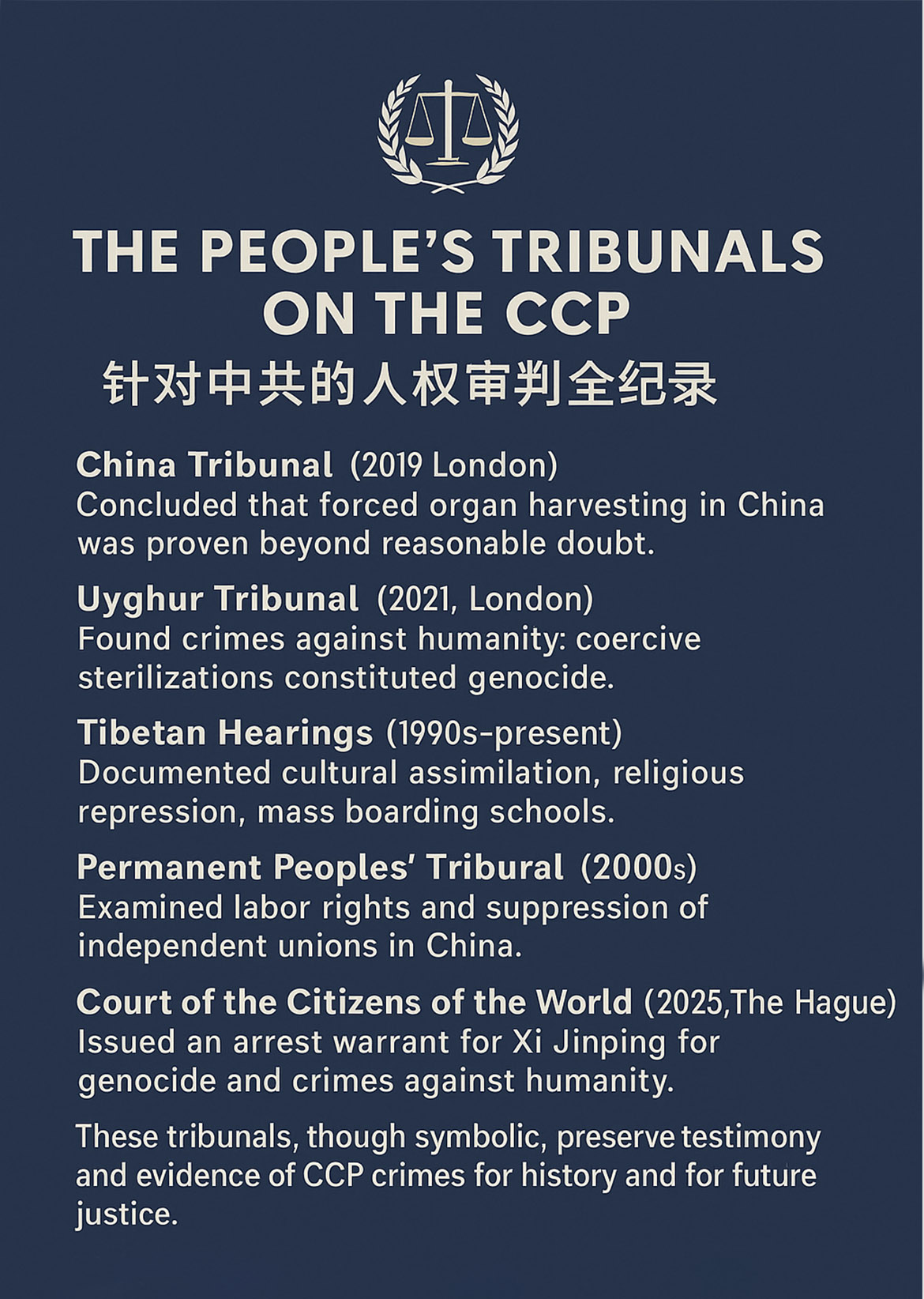
在过去二十年间,围绕中国人权议题,多次出现了由国际法专家、人权律师、独立法官组成的“人民法庭”或“公民法庭”。这些法庭虽不具备联合国或国际刑事法院的强制效力,但其程序透明、证据详实,裁决在国际社会和舆论中具有重要的象征性和参考价值。以下为主要案例的梳理。
一、中国法庭(China Tribunal, 伦敦)
- 时间:2018年–2019年
- 地点:英国伦敦
- 主席:杰弗里·尼斯爵士(Sir Geoffrey Nice KC,曾任前南斯拉夫国际刑事法庭检察官)
- 任务:独立调查中共涉嫌活摘法轮功学员及其他良心犯器官的指控。
- 过程:
- 公开听证共计5天,听取50多位证人、专家和调查人员的证词。
- 收录了医学数据、移植手术统计、医院内部文件等证据。
- 裁决:2019年6月,中国法庭宣判:
- 中共大规模、长期活摘器官的行为已被“确凿证明”;
- 该行为构成“反人类罪”;
- 涉及的器官移植体系规模远超正常捐献水平,无法以“死刑犯器官”解释。
二、维吾尔法庭(Uyghur Tribunal, 伦敦)
- 时间:2020年–2021年
- 地点:英国伦敦
- 主席:杰弗里·尼斯爵士(同上)
- 任务:调查中共在新疆对维吾尔族和其他突厥少数民族的政策。
- 证据范围:
- 前被拘押者的证词,描述“再教育营”内的酷刑、强迫劳动、性暴力;
- 国际研究机构提供的大规模数据,包括出生率骤降、强制绝育政策、DNA采样等;
- 卫星图像显示营地扩建。
- 裁决:2021年12月,维吾尔法庭认定:
- 中共在新疆的政策构成“反人类罪”;
- 部分行为,如强制绝育,构成“种族灭绝”;
- 裁决呼吁国际社会进一步调查并采取行动。
三、西藏人民听证会与法庭
- 时间:1990年代至今,不定期举行
- 地点:欧洲多地(如日内瓦、布鲁塞尔)
- 任务:关注中共在西藏的宗教打压、文化同化和任意羁押问题。
- 内容:
- 听取流亡藏人证词,包括寺庙关闭、僧侣失踪、抗议镇压等案例。
- 聚焦“寄宿学校”制度,数十万藏族儿童被迫进入普通话教育体系,与传统语言、宗教割裂。
- 结果:这些听证虽未形成如“裁决书”般的结论,但为联合国和人权组织的后续报告提供了证据支持。
四、永久人民法庭(Permanent Peoples’ Tribunal, PPT)涉及中国的案件
- 背景:PPT成立于1979年,总部位于意大利罗马,曾对拉美独裁政权、苏哈托政权等作出裁决。
- 涉及中国:2000年代,PPT曾对中国的劳工权利和人权问题召开特别会议,收录关于强迫劳动、工会压制等案例。虽然规模不大,但在学术与非政府人权网络中产生影响。
五、世界公民法庭(The Court of the Citizens of the World, 海牙)
- 时间:2024–2025年
- 地点:荷兰海牙
- 事件:2025年7月12日,该法庭宣布对习近平发布逮捕通告。
- 指控内容:
- 在西藏:强迫转移儿童、任意监禁、迫害平民。
- 在新疆:种族灭绝、酷刑、强奸与强制绝育、强迫失踪、强迫劳动等八项罪行。
- 文件性质:不具备司法强制力,但以正式法律文本的形式提出,呼吁各国政府和国际社会采取措施。
从“活摘器官”的中国法庭,到“种族灭绝”裁决的维吾尔法庭,再到近期“世界公民法庭”的逮捕令,这些独立审判与听证虽然没有国际刑事法院的强制力,但都在记录、整理、公开中共涉及的人权侵害指控,为未来可能的国际法律行动奠定基础。
它们的共同点是:
- 由国际法官、人权律师主持;
- 证据来源广泛,包括证人证词、研究数据、文件与影像;
- 裁决公开透明,接受国际社会检视;
- 虽为“象征性”,但被广泛引用进联合国报告、议会决议和媒体报道。
这些审判与调查构成了一部“民间人权档案”,提醒世界:中共在人权问题上的行为正不断被记录和追责。
A Record of Human Rights Tribunals Targeting the Chinese Communist Party
Over the past two decades, several “people’s tribunals” or “citizens’ courts” composed of international law experts, human rights lawyers, and independent judges have convened to examine allegations of human rights abuses by the Chinese Communist Party (CCP). While these tribunals do not carry the binding force of the United Nations or the International Criminal Court (ICC), their transparent proceedings and extensive evidence collection have given their findings symbolic weight and credibility in international debate. The following is a record of the most significant cases.
The China Tribunal (London)
Held in London between 2018 and 2019, chaired by Sir Geoffrey Nice KC, former prosecutor at the International Criminal Tribunal for the Former Yugoslavia. Its mandate was to investigate allegations of forced organ harvesting from Falun Gong practitioners and other prisoners of conscience in China. Over five days of public hearings, more than 50 witnesses, experts, and investigators gave evidence, including transplant statistics, hospital records, and survivor testimonies.
In June 2019 the tribunal concluded that large-scale, long-term forced organ harvesting had been “proven beyond reasonable doubt” and constituted crimes against humanity. The scale of transplants in China could not be explained by voluntary donations or death-row prisoners alone.
The Uyghur Tribunal (London)
From 2020 to 2021 another tribunal, also chaired by Sir Geoffrey Nice KC, examined CCP policies in Xinjiang directed against Uyghurs and other Turkic Muslim minorities. Testimonies from former detainees described torture, forced labor, sexual violence, and indoctrination in “re-education camps.” International research showed plummeting birth rates, widespread sterilizations, and extensive DNA collection. Satellite imagery documented the rapid expansion of detention facilities.
In December 2021 the tribunal ruled that CCP policies in Xinjiang amounted to crimes against humanity, and that certain acts, particularly coercive sterilizations, met the legal definition of genocide.
Tibetan People’s Hearings and Tribunals
Since the 1990s, hearings have been held in Geneva, Brussels, and other European cities to record abuses in Tibet. Exiled Tibetans testified on monastery closures, disappearances of monks and nuns, and violent crackdowns on protests. Evidence was also presented on the boarding school system, where hundreds of thousands of Tibetan children were separated from their families and placed in state-run schools focused on Mandarin language and political indoctrination.
Although these hearings did not produce formal rulings, their records have informed United Nations and NGO reports.
Permanent Peoples’ Tribunal and China
The Permanent Peoples’ Tribunal, founded in Rome in 1979, has examined human rights abuses in Latin America, Indonesia under Suharto, and elsewhere. In the 2000s it also addressed China in hearings on labor rights and suppression of independent unions. Although less prominent than the China or Uyghur Tribunals, these sessions circulated among NGOs and academic networks and added to the documentation of CCP human rights violations.
The Court of the Citizens of the World (The Hague)
On July 12, 2025, in The Hague, this court announced an arrest warrant for Xi Jinping, President of the People’s Republic of China. The warrant accused him of crimes in Tibet including forcible transfer of children, arbitrary imprisonment, and persecution of civilians, and in Xinjiang including genocide, torture, rape and enforced sterilization, enforced disappearances, forced labor, persecution, and other crimes against humanity.
Although not legally enforceable, the arrest warrant was issued in the form of a legal document signed by three judges, calling on governments worldwide to issue official warrants, take steps to arrest Xi Jinping, and initiate judicial proceedings.
From the China Tribunal’s findings on forced organ harvesting, to the Uyghur Tribunal’s genocide determination, to the symbolic arrest warrant issued by the Court of the Citizens of the World, these initiatives together form a growing body of evidence and moral judgment against the CCP’s human rights record.
Although lacking enforcement power, they share common features: chaired by respected international judges, built on witness testimony and documented evidence, and fully transparent. Their conclusions have been cited in UN reports, parliamentary resolutions, and international media.
Taken together, they represent a civil society archive of human rights violations, preserving testimony and evidence for future legal and historical accountability. They remind the world that the actions of the CCP are being recorded and judged, even when official mechanisms remain stalled.